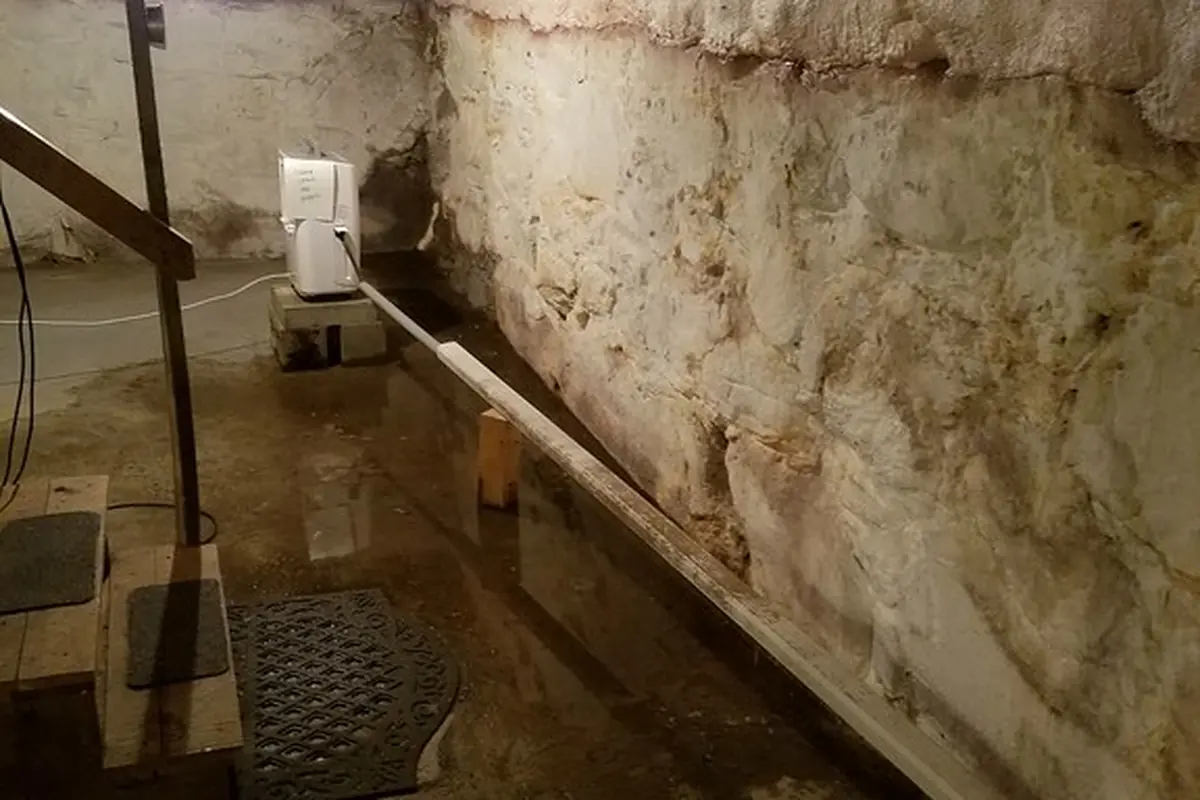
Water where the basement floor meets the wall, at the cove joint, almost always means groundwater pressure beside and under the slab. The floor and walls were poured separately, so the seam between them is the easiest path for water. The lasting fixes relieve that pressure, either with an interior perimeter drain that carries water to a sump, or with exterior drain tile that keeps water from building up in the first place.
Why the cove joint leaks
Builders pour the footing first, then the walls, then the floor slab. Each pour cures separately, so the joint between the floor and the walls never bonds into a single piece. When rain or snowmelt saturates the soil and the footing drain cannot keep up, water rises around the footing and under the slab. That pressure, called hydrostatic pressure, pushes water in at the weakest point, usually that seam.
Signs it is a cove joint leak
- A wet line along the floor edge, sometimes all around the room.
- Water that appears a day or more after heavy rain or during spring melt.
- Dampness that starts at the floor and moves up the wall, not the other way around.
- A sump that runs hard, or a basement with no sump at all.
Why it is common around Rochester
Many Rochester-area homes have footing drains that are decades old, and much of the region has heavy soil that drains slowly. City neighborhoods along the river and the former canal route are full of these foundations. Lake-effect snow adds a big spring meltwater load; the National Weather Service in Buffalo tracks it every winter.
Repairs that work
Interior perimeter drain. A contractor cuts a narrow strip of the floor along the walls, installs perforated pipe in stone beside the footing, and connects it to a sump pit. Water that reaches the joint is captured under the floor before it can rise onto it. Block walls may get weep holes at the bottom course. See wet or leaking basements.
Exterior drain tile. Excavating to the footing and replacing the drain stops water from building up against the wall at all. It costs more but also keeps the wall itself drier. See exterior drain tile.
A working sump. Either approach usually depends on a reliable sump pump with good discharge. See sump pumps.
Repairs that rarely last
Caulk, hydraulic cement and sealer paints along the joint may hide the water for a season. Under pressure, water simply moves a few inches over. Our post on whether basement sealer paints work explains why.
Before you call
Note when the water appears, how much there is, whether it follows rain or melt, and whether you have a sump. Check outside first: short downspouts and soil sloping toward the house make cove joint leaks much worse, and fixing them is cheap. See also signs of a clogged footing drain.
Common questions
Can I seal the cove joint with caulk or hydraulic cement?
It may slow minor seepage, but under real water pressure the water usually finds another path, often a few inches away. Sealing the joint does not relieve the pressure that pushes the water in, so most contractors treat it as a temporary measure.
Why does water only come in at the joint and not through the walls?
The floor and the walls are poured separately, so the joint between them is the weakest point. When groundwater rises around the footing, it takes the easiest path, which is usually that seam.