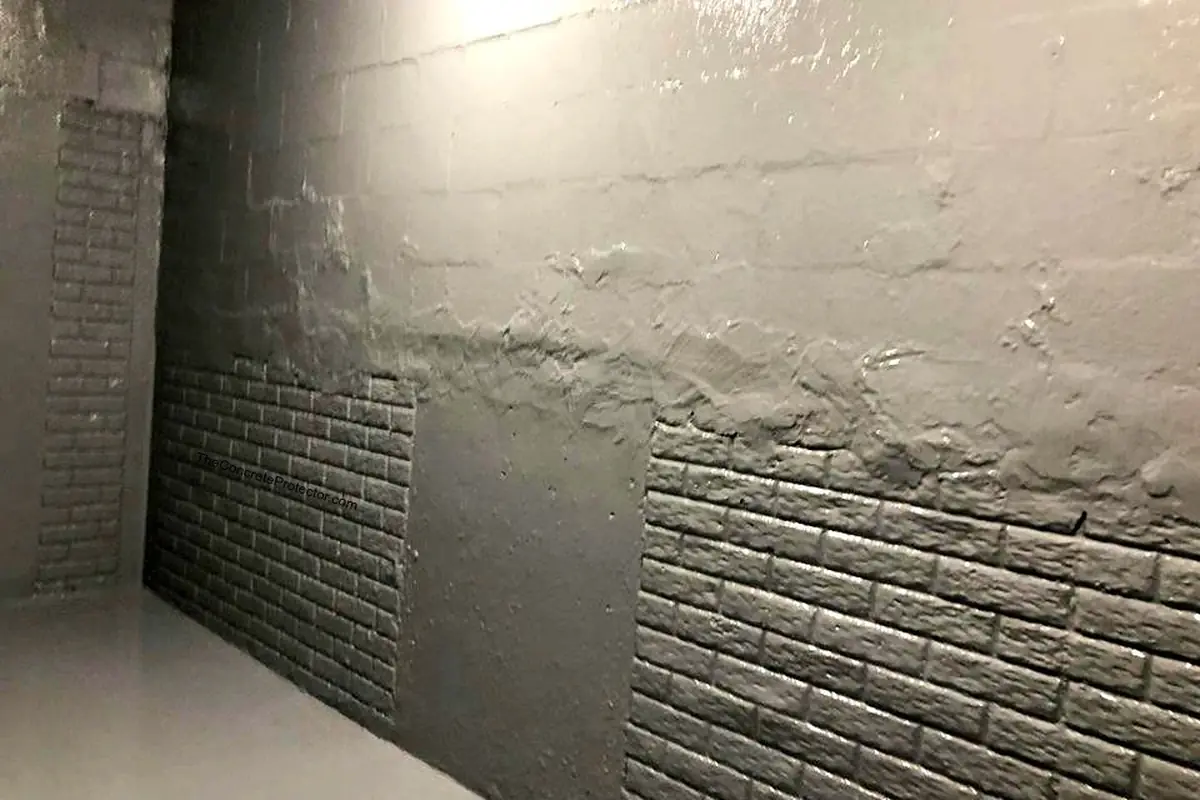
Basement waterproofing paints and masonry sealers work on walls that are only slightly damp, where moisture moves through the concrete slowly and there is no water under pressure. They do not stop active seepage, leaking cracks, or water at the floor-wall joint. On walls with real water behind them, coatings usually blister and peel, often with white mineral deposits pushing through.
What the coatings are
Most products fall into a few groups. Cement-based coatings are brushed on thick and bond to the masonry. Acrylic and latex "waterproofing" paints form a film on the surface. Penetrating sealers, often silicate-based, soak in and react with the concrete to reduce its porosity. All of them work on the inside face of the wall, which means water still reaches the wall from outside.
Where they help
- On a poured wall that feels cool and slightly damp but never shows water.
- To reduce dusting and minor dampness on a block wall that is otherwise dry.
- As a finish over a wall that has already been made dry by drainage work.
- In a basement where humidity, not seepage, is the main issue, paired with a dehumidifier.
Where they fail
Water under pressure. When groundwater builds up against the outside of a wall, no paint on the inside can hold it back. The water pushes through, lifts the coating and finds the edges.
Block walls holding water. Hollow concrete blocks can fill with water. Painting the inside traps it until it seeps out at the bottom course or the floor joint.
Stone and brick foundations. Older foundations in Rochester neighborhoods such as Corn Hill, the South Wedge and Maplewood are built with lime mortar and stone that need to breathe. Sealing them can trap moisture and speed up mortar decay.
Cracks and joints. Coatings bridge hairline gaps at best. Leaking cracks need injection or exterior repair.
Efflorescence is a warning sign
White, powdery deposits on a basement wall are minerals left behind by evaporating water. They mean water is moving through the wall. Coating over them rarely works; the minerals keep forming under the paint and push it off.
What to do instead
Start outside. Most damp walls get better when roof water is kept away from the foundation and the soil slopes away from the house; see downspouts and yard drainage. If dampness continues, a contractor can assess the wall. Real fixes for an actively wet wall are exterior membranes, interior drainage, or crack injection. See wall waterproofing for how they work.
If the problem is more about a musty smell than visible water, read musty basement with no puddles. If the wetness is concentrated at the bottom, read water where the floor meets the wall.
About mold
Damp walls behind paint or paneling can grow mold. The EPA's mold and moisture page explains why controlling the moisture comes first.
The honest answer
Coatings are a finish, not a waterproofing system. Use them on dry or nearly dry walls. When water is actively coming through, fix the water first.
Common questions
Why is my basement paint peeling and bubbling?
Water moving through the wall pushes against the coating from behind. As it evaporates, it leaves minerals that build up under the paint, which then blisters and flakes. Peeling is a sign the wall has an active moisture problem that a coating cannot hold back.
Can I paint over efflorescence?
Not successfully. The white powder is minerals carried by water through the wall. Brush it off and find out where the water is coming from first. Painting over it usually leads to peeling within a season.