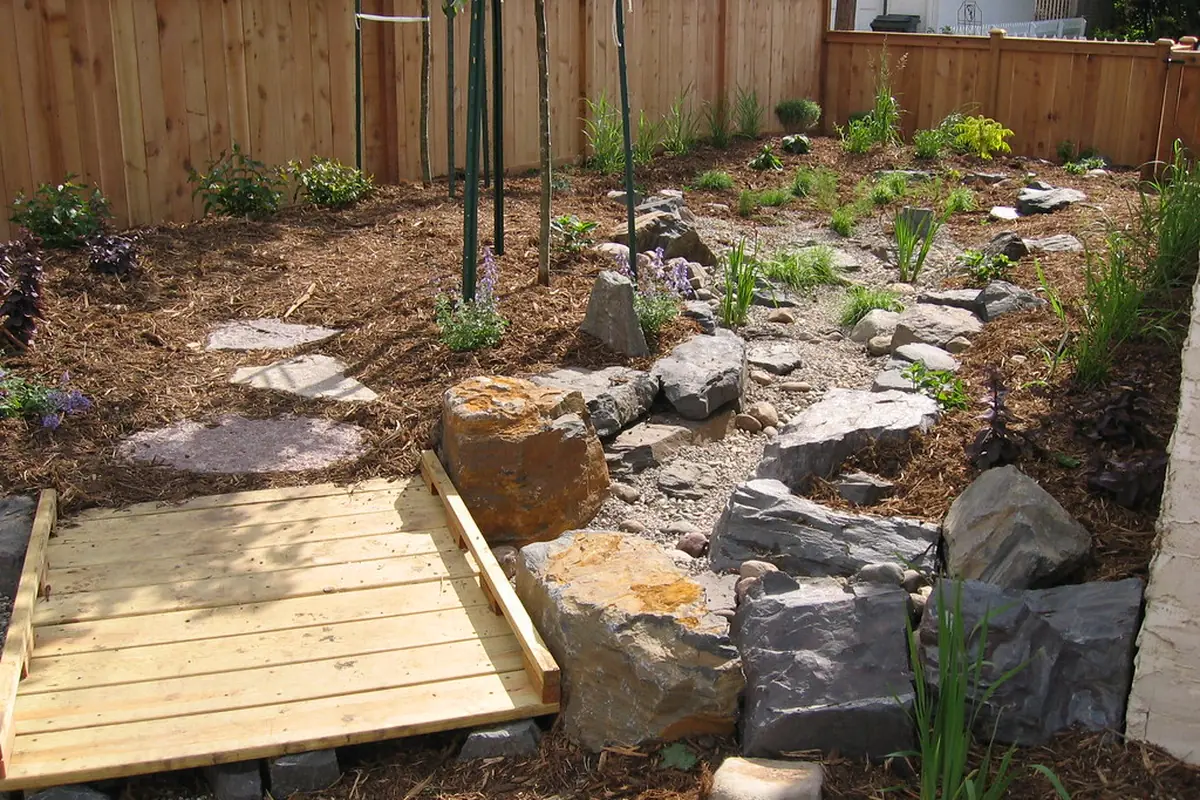
A rain garden can handle downspout water in a Rochester yard if it sits at least ten feet from the foundation, lower than the house, and in soil that drains well enough to empty within a day or two after a storm. It is a shallow, planted basin that collects roof runoff and lets it soak into the ground slowly instead of pooling against the basement wall.
How a rain garden works
A downspout extension or a short buried pipe carries roof water to a shallow depression, usually four to eight inches deep. The basin is filled with loose soil and planted with species that tolerate both wet and dry spells. During a storm, the garden fills; afterward, the water soaks in. The EPA's Soak Up the Rain program describes rain gardens as one of the simplest ways homeowners can reduce runoff.
Where to put it
- Away from the foundation. At least ten feet is a common guideline, so the water does not simply soak into the backfill next to the basement.
- Downhill. The garden must sit lower than the house, or the water will flow back.
- Away from septic systems, wells and utilities. Call Dig Safely New York before digging, even for a garden.
- Not on a neighbor's line. Keep the overflow on your property.
The soil question
Much of the Rochester area has heavy, clay-rich soil that drains slowly, especially in flat towns like Henrietta and parts of Greece and Ogden. To test yours, dig a hole about eight inches deep where you plan the garden, fill it with water, and see how long it takes to drain. If it empties within a day, a rain garden can work. If water sits for several days, you will need to amend the soil heavily, build a larger, shallower garden, or choose another approach.
Plants that fit
Native plants with deep roots do the best job of opening up soil and tolerating Rochester winters. Many gardeners use mixes of native grasses, sedges and flowering perennials. Highland Park, home to the Lilac Festival and the Lamberton Conservatory, is a reminder of how well plants thrive in this climate when they are matched to the site.
Sizing it
A rough approach is to size the garden at a fraction of the roof area that drains to it, deeper soils needing less and slow soils needing more. Many homeowner guides offer simple worksheets. Make it wider and shallower rather than deep.
When a rain garden is not enough
A rain garden manages surface water from the roof. It does not stop groundwater from coming through walls or the floor. If your basement still leaks during long rains or snowmelt after the roof water is handled, the problem is probably below grade. See exterior drain tile or wet or leaking basements. For other ways to move roof water, see downspouts and yard drainage.
Pairing it with other fixes
Rain gardens work best alongside the basics: clean gutters, downspouts that carry water well away from the house, and soil that slopes away from the foundation. On a tight lot, a rain garden may not fit at all; see downspouts on narrow city lots. And if your sump pump runs constantly, read why a sump pump runs nonstop.
Common questions
Will a rain garden attract mosquitoes?
A well-built rain garden drains within a day or two after a storm, which is faster than mosquitoes need to breed. If water stands for several days, the soil is not draining well enough and the garden needs to be rebuilt or moved.
Can a rain garden replace a sump pump?
No. A rain garden handles surface water from the roof. A sump pump handles groundwater from around and under the foundation. Many homes benefit from both, but one does not replace the other.